I am the proud parent of a teenager with a Learner's Permit.
In Virginia, where we live, according to the Department of Motor Vehicles the rules for getting a permit and license are as follows:
To obtain a learner's permit in Virginia, you must be at least 15 years and 6 months of age. You must hold a learner's permit at least nine months and provide proof of successful completion of a state-approved driver education program before you can receive a driver's license. In addition, your parent, guardian or foster parent must provide his or her driver's license or state-issued identification card number and certify that you received at least 45 hours of driver practice, 15 of which must have been competed after sunset.
As opposed to years past, not all teens are racing to get their driver's license as soon as they turn 16, and in states such as Virginia they need to be 16 years and 3 months at minimum. Some teens are not interested in learning to drive at all, and don't even get a learner's permit. I have also heard comments from parents recently about the conditions they insist must be met before their teen can get a learner's permit, such as reaching a certain rank in Boy Scouts. Other parents are just waiting until their child expresses some interest in driving before getting their permit.
I didn't get my license until I was 18, although I had my permit for a few years. I definitely felt like I did not get enough practice before I was granted a license, and sort of taught myself to become a competent driver through "on-the-road" training.
I am very comfortable with my son having his permit, because it will allow for the maximum amount of driving practice. We are in no hurry to get his license, but I see no reason to wait to get a permit. At least for us, there is no additional cost in insurance until a new driver actually gets their license. There is a lot of research showing the lower crash rates of teen drivers when teens must wait until they are 17 to get a license.
We are taking the driving training slowly; we live in an area with lots of traffic, everywhere, all the time. This time is essential for us parents to share advice, instill confidence, and judge competence before allowing independent driving. So far the driving is going pretty well, although we haven't ventured too far from home yet. We still need to make it out to the highway when it's quiet, not an easy feat!
I think any conditions need to be saved for actually getting a license. Kids need as much practice time as they can get, especially in this region. More time driving with a permit should develop a teen into a safer, more confident driver than rushing the minimum required practice into nine months.
Sunday, September 14, 2014

Sunday, September 7, 2014
File Therapy
Some people have issues with their weight. I have issues with clutter. Not the "Hoarder with dead cat behind the couch" type of clutter. More the "I might need this some day, I don't have a parent's basement to keep old stuff in, I'm not ready to make a decision about that yet, I'm not sure about that so I'll keep it" kind of clutter. Lots of papers, mini Allen wrenches from Ikea furniture kits, stubby pencils, coupons, recipes... you get the idea.
I have always been this way. Early in my marriage, we didn't have a set plan on bill paying, and a few bills got lost in piles of paper. But I am always trying to get better and I think I have improved with age. I am now the designated bill payer, and we have a simple system of magazine files for important mail to get put into, so at least it isn't getting lost!
We have had the same 4-drawer file cabinet for about 18 years. I think there are papers in it since the day it arrived in our first apartment. For a long time now I have been dreaming of reorganizing the entire file cabinet, especially after I was having trouble closing the drawers. I am pretty good at filing papers; I'm not very good at weeding out the old stuff we don't need anymore.
I happened to see a picture of a newly re-organized file cabinet, and I was inspired. I saw this on the Blog a bowl full of lemons and thought maybe I could actually do something similar:
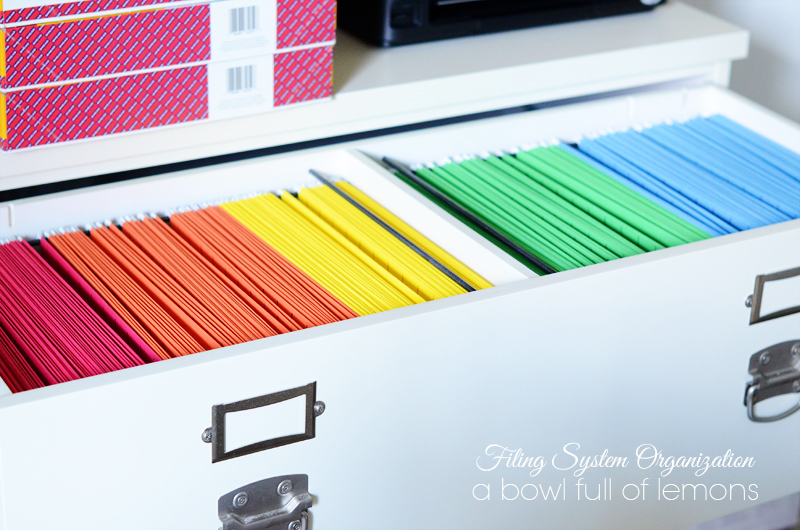
The blogger spent one day reorganizing her files into color-coded hanging folders.
Well, I've spent one week, and I'm still not done! But I have made huge progress.
I started out ordering boxes of colored hanging folders. Oops! I thought I was getting five colors, but it was only four. Sigh. I got new labels for the folder tabs, and decided how I wanted to organize the files we have.
I came up with five basic categories: Home/Auto/Medical for insurance, repair and maintenance records; Rental Property records; Financial, for investments, bank accounts and taxes; Monthly Expenses including utilities, credit cards and other bills; and miscellaneous family and school records. I assigned a color to each category, although the Monthly Expenses and Financial groups have to share because I don't know how to read a product description correctly. Hopefully they will get along. This is still a work in progress, but it seems to be working so far.
Ten-year old "This is Not a Bill" insurance statements and similar items have been sent to the shred pile. I'm hopefully hanging onto the things we are supposed to save. There is a basic list of how long to keep documents here on the USA.gov site. My husband is even more conservative about how long to keep certain tax and investment records so they get a pass for now.
My files don't look quite as pretty as the photo above, but they will soon! And then I will post my own photo so stay-tuned.
Friday, September 5, 2014
Bi-Partisan Nitwits
In Virginia, our former governor Bob McDonnell and his wife Maureen were found guilty of corruption yesterday. I really don't put too much faith in politician's claims about their values and beliefs, but when they enact legislation that affects me I do need to pay attention. He has stated that his ideas have evolved with time, but 20 years ago he wrote that working women and feminists were 'detrimental' to the family. I'm not sure what an untested "miracle drug" based on tobacco was supposed to do for families other than take their money and give false hope.
Yesterday I happened to read a story about Secretary of State John Kerry on a conservative Facebook page. Kerry was addressing a group of Muslim Americans and supposedly made a comment about America having a biblical responsibility to protect Muslim countries from the effects of climate change. I made the serious mistake of reading some of the comments, and they make me truly worry for the future of this country.
I believe climate change is real and important, as is corruption. I'm curious if the corruption will get the same response as climate change. (ie silly John Kerry quoting the bible to defend policy of man-made weather problems). So far the "conservative" comments I've read about the McDonnell case mainly suggest that if McDonnell was a Democrat instead of a Republican he would have gotten off with just a slap on the hand. And that most jurors are unemployed welfare recipients (and obviously Democrats).
As it turns out corrupt politicians happen to be a pretty bipartisan bunch. Mainly I need to stop reading comments written by any nitwits who can't spell and who think any interpretation of religion, science or politics other than their own is wrong.
But we have survived this long, and nitwits are not a new invention of any political party or philosophy, or even the internet. Keep Calm and Ignore the Nitwits!
Yesterday I happened to read a story about Secretary of State John Kerry on a conservative Facebook page. Kerry was addressing a group of Muslim Americans and supposedly made a comment about America having a biblical responsibility to protect Muslim countries from the effects of climate change. I made the serious mistake of reading some of the comments, and they make me truly worry for the future of this country.
I believe climate change is real and important, as is corruption. I'm curious if the corruption will get the same response as climate change. (ie silly John Kerry quoting the bible to defend policy of man-made weather problems). So far the "conservative" comments I've read about the McDonnell case mainly suggest that if McDonnell was a Democrat instead of a Republican he would have gotten off with just a slap on the hand. And that most jurors are unemployed welfare recipients (and obviously Democrats).
As it turns out corrupt politicians happen to be a pretty bipartisan bunch. Mainly I need to stop reading comments written by any nitwits who can't spell and who think any interpretation of religion, science or politics other than their own is wrong.
But we have survived this long, and nitwits are not a new invention of any political party or philosophy, or even the internet. Keep Calm and Ignore the Nitwits!
Thursday, September 4, 2014
Surprise Me
Many people are currently writing about things they are grateful for in their lives. So I decided to do something different. I do have many, many things that I am grateful for. I live an extremely privileged life, I'll just get that out of the way.
More fun to me is to think about the things in my life that surprise me.
I remember as a teenager lying on the beach in Evanston, looking out over Lake Michigan, and thinking something along the lines of "Maybe my future husband is across the lake." I really wasn't one to swoon and wax romantic, but I guess I figured my life might follow a familiar trajectory. But I was shy, introverted and a late bloomer, and it was hard to see that future as a reality.
One surprise is that my future husband WAS basically across the lake! He grew up in Ohio. But if you had told me that I would marry a guy from a really small town who lived on a Christmas tree farm and had chores like feeding steers I would have sent you in for serious questioning! This was not the future husband I had envisioned. If I described his family background a different way, you would see only similarities with mine, however. We both had parents who were academics from New England, both had parents who were the first generation in their families to go to college, both are one of four siblings. These and other similarities are what made us compatible despite pretty different upbringings.
I am a committed feminist... my definition of a feminist is anyone who appreciates a woman's right to vote and own property. I worked at one of the places anti-feminists love to hate most, Planned Parenthood (one of my most memorable jobs which I might write a separate post about). Despite that I have had a surprisingly traditional married life. I haven't worked full time since the day before I became a mother, and sporadically since then. This has been for a variety of reasons, and I fully appreciate my situation. I do most of my family's cooking, laundry and cleaning. But years ago, I never pictured myself having the patience to be a "stay at home mother". I also thought I would have four kids, but that was before I ever had any!
I'm not sure what the future holds for me as my kids and I get older, but I am grateful to have many options.
My children are complete surprises to me. I did gestate and give birth to both of them, but there have been numerous times I have looked at them and thought "Now where did you come from again?" I thought parenting would be easier, starting with trying to feed the first one. But at a phase when many people are worried about the path their kids will take, I see my sons maturing, making great choices and helping each other out in ways that I didn't see before. I even see myself in them in ways maybe I can't define. My sense of humor, love of reading, occasional anxiety, irreverance and sarcasm all show up in my kids. Hopefully some more positive qualities will too!
So often we have tunnel vision about our lives, and forget that every day brings new surprises for all of us. Here's hoping for some good ones.
More fun to me is to think about the things in my life that surprise me.
I remember as a teenager lying on the beach in Evanston, looking out over Lake Michigan, and thinking something along the lines of "Maybe my future husband is across the lake." I really wasn't one to swoon and wax romantic, but I guess I figured my life might follow a familiar trajectory. But I was shy, introverted and a late bloomer, and it was hard to see that future as a reality.
One surprise is that my future husband WAS basically across the lake! He grew up in Ohio. But if you had told me that I would marry a guy from a really small town who lived on a Christmas tree farm and had chores like feeding steers I would have sent you in for serious questioning! This was not the future husband I had envisioned. If I described his family background a different way, you would see only similarities with mine, however. We both had parents who were academics from New England, both had parents who were the first generation in their families to go to college, both are one of four siblings. These and other similarities are what made us compatible despite pretty different upbringings.
I am a committed feminist... my definition of a feminist is anyone who appreciates a woman's right to vote and own property. I worked at one of the places anti-feminists love to hate most, Planned Parenthood (one of my most memorable jobs which I might write a separate post about). Despite that I have had a surprisingly traditional married life. I haven't worked full time since the day before I became a mother, and sporadically since then. This has been for a variety of reasons, and I fully appreciate my situation. I do most of my family's cooking, laundry and cleaning. But years ago, I never pictured myself having the patience to be a "stay at home mother". I also thought I would have four kids, but that was before I ever had any!
I'm not sure what the future holds for me as my kids and I get older, but I am grateful to have many options.
My children are complete surprises to me. I did gestate and give birth to both of them, but there have been numerous times I have looked at them and thought "Now where did you come from again?" I thought parenting would be easier, starting with trying to feed the first one. But at a phase when many people are worried about the path their kids will take, I see my sons maturing, making great choices and helping each other out in ways that I didn't see before. I even see myself in them in ways maybe I can't define. My sense of humor, love of reading, occasional anxiety, irreverance and sarcasm all show up in my kids. Hopefully some more positive qualities will too!
So often we have tunnel vision about our lives, and forget that every day brings new surprises for all of us. Here's hoping for some good ones.
Wednesday, September 3, 2014
Reflections on Life
Today would be my mother's 87th birthday. She died over twenty years ago, two years before my father.
 |
| My parents and my oldest sister |
Some years back I was talking with a co-worker about family. Upon learning that both my parents were no longer living, she expressed sorrow about that situation. "Doesn't that make you so sad?" she asked. "Don't you wish they were still alive?"
The answer, of course, was yes. But to me it was a more complicated question and answer.
In my ideal life, both my parents would have been healthy and alive. They would have been there to enjoy my graduations, wedding, and motherhood together. They would have been there to give me advice, support and encouragement, share jokes and family history, and to cry together. But life is never ideal.
I have often thought about what life would be life if my parents had lived longer than they did. My mother was 67 when she died after a 17 year struggle with Alzheimer's disease. My father died two years later at age 73, greatly affected by my mother's illness.
My mother's relatively young age during her illness meant her healthier and stronger body kept going long after her mind shut down. In her final years she was bedridden and had been non-verbal for many more. I hardly knew her as a vibrant, healthy woman. Extending this life would have been cruel.
I have never believed in an afterlife, partly because it hurts my brain to have to decide which version of someone would be eternal. I know the idea of eternal life gives many people comfort, but it never did me. I attended two memorials this summer for people who died far too young. The promise of comfort in Heaven was a major theme of both services. I understand why this speaks to people, but it is not part of my belief system.
In a similar way, I can imagine many scenarios in which my parents are healthy, happy and alive. But so many things would need to change for that to be a reality. How do we decide what to change? Do I get my parents alive but sick? And if there is no illness in this reality, then so many things about me and my life would probably be different. It's like George Bailey in "It's a Wonderful Life" seeing the world without his presence. Life as we know it would just not happen.
Life can be like a Theater of the Absurd production. Crazy, seemingly meaningless, without logic. But here we are, and to dwell on the What-Ifs of life is even more meaningless. Not to get too Oprah-ish... but all we can do is be present, enjoy the world around us and live the best life we can. When I was a kid we ate dessert every day, and that is a great memory and a great way to live!
Tuesday, September 2, 2014
The Kids' (Meals) are Alright
With school starting up again recently, kids and food has been a popular topic in the blogosphere. How to feed your kids healthy food, the best foods to feed your kids, amazing lunches to pack for your kids, the importance of variety in kids' lunches. The list goes on, and usually has some number in front of it (the 10 best, the 11 most important, the 7 worst foods to feed your kids!). Some of them certainly give good advice, but should be looked at as part of a bigger picture. No food is ever only good or only bad, and much advice seems to ignore the realities of life.
I have always been an advocate for a healthy diet for anyone. I made most of the baby food we fed our kids when they started solid foods. I encourage them to eat healthy now, and try to make healthy meals for all of us. We discuss how much sugar is in cereal, how much sodium is in soup and lunchmeat, and why soda counts as dessert. There is nothing that is never allowed.
Despite my healthy focus, much of the advice I read drives me crazy! To me, it is just not honest and is far too guilt-inducing for most real people. I'm not advocating a straight diet of Cheetos and Lunchables, but most of the advice I'm reading seems to forget that kids become adults who are allowed, even expected, to have their own tastes, preferences and decisions to make regarding food. We are encouraged not to cater to the requests of our kids, but we certainly cook to please our spouses and other adults.
I understand that children should be exposed to a variety of food, taught to eat what is healthy as well as what is available and to be appreciative of whatever is served to them. However, as someone with food allergies, I could never just eat what was given to me. Unless I have cooked my meal myself, I almost always have to start out asking many questions, and sometimes decide not to eat something instead of risking getting sick.
My kids have definitely not been trained to just eat what is presented to them, because I have not modeled that behavior for them. But I actually think this is a healthier way to eat. We want our kids to be thoughtful eaters, choose healthy foods, and stop eating when they are full. I don't expect rudeness, but being a member of the clean plate club should not be a requirement anymore!
My husband is from a family where there were no alternate meals prepared, and the kids were expected to finish what was on their plate. However, as in many families, I suspect, much food was sneaked into napkins or fed to the dog.
I have seen much importance put on having kids help plant and pick their own food. The idea is that they will be more likely to try it if they have helped grow it. For many years we have had a vegetable garden at home in the summer. We have tried corn, carrots, tomatoes, squash, peppers, cucumbers, beans, basil, sweet potatoes. One of our kids finally admitted to liking the fresh cucumbers, but will eat nothing else from the garden. And both of them enjoyed planting and harvesting sweet potatoes, but have never eaten a single one. Same goes for tomatoes. Maybe someday they will appreciate it but for now my attitude is "more for me".
My kids and husband all turn up their noses at kale salad. So I make it for myself and don't push it on the others. We do all eat a lot of broccoli because it is one green vegetable that everyone likes. I would rather serve a healthy food I know will get eaten than fight over a spoonful of rejected kale.
My oldest son discovered that when he is hungry enough, such as on a 10 day backpacking trip, he will eat anything. He came home from that trip requesting all kinds of exotic food he had previously refused. Like lasagna, which is now a family favorite. My younger son has always had a wider palate, and now enjoys cooking and baking. But he still has certain things he will not eat, such as fish. He has never taken a peanut butter and jelly sandwich to school, while I am still making one almost every day for my older one. I have encouraged tastes, but I have never forced them to eat a plateful of something they don't like.
Kids adapt and change and develop their tastes over time. We should let them! I truly believe this will lead to healthier and more mindful eaters
I have always been an advocate for a healthy diet for anyone. I made most of the baby food we fed our kids when they started solid foods. I encourage them to eat healthy now, and try to make healthy meals for all of us. We discuss how much sugar is in cereal, how much sodium is in soup and lunchmeat, and why soda counts as dessert. There is nothing that is never allowed.
Despite my healthy focus, much of the advice I read drives me crazy! To me, it is just not honest and is far too guilt-inducing for most real people. I'm not advocating a straight diet of Cheetos and Lunchables, but most of the advice I'm reading seems to forget that kids become adults who are allowed, even expected, to have their own tastes, preferences and decisions to make regarding food. We are encouraged not to cater to the requests of our kids, but we certainly cook to please our spouses and other adults.
I understand that children should be exposed to a variety of food, taught to eat what is healthy as well as what is available and to be appreciative of whatever is served to them. However, as someone with food allergies, I could never just eat what was given to me. Unless I have cooked my meal myself, I almost always have to start out asking many questions, and sometimes decide not to eat something instead of risking getting sick.
My kids have definitely not been trained to just eat what is presented to them, because I have not modeled that behavior for them. But I actually think this is a healthier way to eat. We want our kids to be thoughtful eaters, choose healthy foods, and stop eating when they are full. I don't expect rudeness, but being a member of the clean plate club should not be a requirement anymore!
My husband is from a family where there were no alternate meals prepared, and the kids were expected to finish what was on their plate. However, as in many families, I suspect, much food was sneaked into napkins or fed to the dog.
I have seen much importance put on having kids help plant and pick their own food. The idea is that they will be more likely to try it if they have helped grow it. For many years we have had a vegetable garden at home in the summer. We have tried corn, carrots, tomatoes, squash, peppers, cucumbers, beans, basil, sweet potatoes. One of our kids finally admitted to liking the fresh cucumbers, but will eat nothing else from the garden. And both of them enjoyed planting and harvesting sweet potatoes, but have never eaten a single one. Same goes for tomatoes. Maybe someday they will appreciate it but for now my attitude is "more for me".
My kids and husband all turn up their noses at kale salad. So I make it for myself and don't push it on the others. We do all eat a lot of broccoli because it is one green vegetable that everyone likes. I would rather serve a healthy food I know will get eaten than fight over a spoonful of rejected kale.
My oldest son discovered that when he is hungry enough, such as on a 10 day backpacking trip, he will eat anything. He came home from that trip requesting all kinds of exotic food he had previously refused. Like lasagna, which is now a family favorite. My younger son has always had a wider palate, and now enjoys cooking and baking. But he still has certain things he will not eat, such as fish. He has never taken a peanut butter and jelly sandwich to school, while I am still making one almost every day for my older one. I have encouraged tastes, but I have never forced them to eat a plateful of something they don't like.
Kids adapt and change and develop their tastes over time. We should let them! I truly believe this will lead to healthier and more mindful eaters
Monday, September 1, 2014
Remember the Nutty '70s??
As summer comes to a close, and school starts back up, there has been a lot of reminiscing going on. Recently there have been a few versions of "What I loved about growing up in the 1970s" floating around the internet. Favorites memories (real or experienced via Brady Bunch reruns) include riding in the Way back of the station wagon without seatbelts, wandering around with friends for hours with no parental supervision, and taking lots of peanut butter sandwiches to school and not worrying about anyone's food allergies.
While my family never had a station wagon, and I didn't even watch The Brady Bunch very often, I did experience a different level of parental hovering and involvement than what is expected today. I don't remember my parents obsessively checking on my homework status or needing to know where I was every second of the day. I was sent alone on foot to the local small grocery story well under the age of 10, took the city bus alone at age 9, and walked downtown with friends after elementary school let out for the afternoon.
One area where I think increased parental involvement and awareness in general is good is the realm of food allergies. People may snicker, be annoyed or feel inconvenienced by what seems to be an epidemic of kids with food allergies. To these kids, however, allergies can be scary, can ruin a fun time, and at worst can be deadly.
In the 1970s my allergies were mostly treated as a curiosity or minor inconvenience... to me! I don't remember any teacher, camp counselor or friend's parent being aware of my allergies. I had a number of experiences eating food I was allergic to, possibly because I wasn't taught well enough to ask if foods had allergens in them. One of my most vivid memories from summer day camp was eating candy offered to me by a camp counselor, getting sick and discovering after the fact that Bit o' Honey candy contains nuts.
My family attempted to avoid foods they know made me sick at home, but there was not complete avoidance. My mom made chocolate cookie dough without nuts for me, and when those were baked she threw walnuts in the rest. There were always two clearly labeled tins, and amazingly I never ate the wrong ones!

Unlike kids with allergies I know today whose parents scrutinize any minor rash or reaction to determine what caused it, I was left to self-diagnose some of my symptoms and reactions on my own over time. It may have been the era of "If the doctor didn't mention it, we don't need to worry about it." It is true that food allergies are increasing, and the cause is not clearly understood. But they are real and can be really hard for kids to deal with.
I'm all for letting kids have more of the freedoms we feel like we left behind 30 years ago. But when it comes to food allergies it is time for all parents to increase their knowledge, advocacy, communication and compassion.
Tuesday, May 27, 2014
God Bless America
Memorial Day has just passed. This is a day to remember and honor our veterans and those who didn't make it back from the fight.
I had the opportunity to attend the rally held for several thousand motorcycle riders who were leaving from Northern Virginia to ride into Washington, DC for the 800,000 strong Rolling Thunder experience. This was my first time being involved with this event sponsored by a local Harley Davidson dealership. The local marching band marched over and played a few songs. The firefighters' bagpipe band played. And numerous local politicians, veterans' representatives and motorcycle enthusiasts appeared on stage.
There were several moving speakers, including a former soldier who represents the Wounded Warrior Project, as well as the former commander of the USS Cole. They spoke of courage and American bravery. They spoke of America's greatness and commitment. They spoke of POWs and MIAs. They spoke of Freedom.
I am a proud American. My father fought with the US Army in World War II in Europe. I was raised to understand that there are few places in the world where everyone really does have the chance to live, worship, learn and teach freely. And this after my parents experienced religious discrimination personally in the Good Ol' US of A. Through the years how many soldiers have fought bravely only to return to find certain jobs, schools and neighborhoods out of reach because of their religion or race?
Religious freedom means different things to different people. It can mean the freedom to believe or worship as you wish. The freedom to not be coerced into a particular religion. And in this country it also means the freedom to not believe, to have the ultimate freedom FROM religion.
Based on this, I found the speakers on Sunday a bit hypocritical. With all their talk of freedom, including the freedom to ride motorcycles, they seemed to have forgotten one. As the politicians and others followed one after another to greet the crowd and say inspiring words, they picked up a motto which was repeated like a drumbeat throughout the morning: "God Bless America".
What happens if I don't believe in God? Or don't believe in the same God? Or don't worship the same way as you? I only ask that people really think about what God Bless America means. Let's not use it to stir up patriotic fervor which doesn't represent the real freedom that America stands for.
I had the opportunity to attend the rally held for several thousand motorcycle riders who were leaving from Northern Virginia to ride into Washington, DC for the 800,000 strong Rolling Thunder experience. This was my first time being involved with this event sponsored by a local Harley Davidson dealership. The local marching band marched over and played a few songs. The firefighters' bagpipe band played. And numerous local politicians, veterans' representatives and motorcycle enthusiasts appeared on stage.
There were several moving speakers, including a former soldier who represents the Wounded Warrior Project, as well as the former commander of the USS Cole. They spoke of courage and American bravery. They spoke of America's greatness and commitment. They spoke of POWs and MIAs. They spoke of Freedom.
I am a proud American. My father fought with the US Army in World War II in Europe. I was raised to understand that there are few places in the world where everyone really does have the chance to live, worship, learn and teach freely. And this after my parents experienced religious discrimination personally in the Good Ol' US of A. Through the years how many soldiers have fought bravely only to return to find certain jobs, schools and neighborhoods out of reach because of their religion or race?
Religious freedom means different things to different people. It can mean the freedom to believe or worship as you wish. The freedom to not be coerced into a particular religion. And in this country it also means the freedom to not believe, to have the ultimate freedom FROM religion.
Based on this, I found the speakers on Sunday a bit hypocritical. With all their talk of freedom, including the freedom to ride motorcycles, they seemed to have forgotten one. As the politicians and others followed one after another to greet the crowd and say inspiring words, they picked up a motto which was repeated like a drumbeat throughout the morning: "God Bless America".
What happens if I don't believe in God? Or don't believe in the same God? Or don't worship the same way as you? I only ask that people really think about what God Bless America means. Let's not use it to stir up patriotic fervor which doesn't represent the real freedom that America stands for.
Wednesday, March 5, 2014
Finding the Time to Exercise

I'm a big believer in the "Do What Works for You" method of living.
I admit to some biases. I do think we all benefit individually and as a community, and are generally healthier, when we don't smoke, try to eat healthy food and exercise regularly. The details of what the last two mean are not written in stone. However, there is apparently money to be made in telling us exactly what we should and should not do. Just today, I found myself annoyed by all the Facebook posts about the 10 Things I Should Never Do If I Want to Have a Happy Life, or the 8 Things I'm Doing Wrong when I Unload my Groceries, and the 6 Things I Must Do in Order to Live Forever. This got me thinking about When I Exercise.
I'm lucky with the flexible schedule I have for exercise. I generally go to the gym in the morning after everyone has left for work and school. My Darling Husband has lately been joining a class at the gym 3 days a week which meets at... 6 AM. I used to attend the same class, which includes weight training twice a week and interval cardio once a week, a few years ago. It was hard getting up at 5:00 AM, but I always felt great the rest of the day. On occasion, like today when we had a 2 hour school delay, I still join my DH for the early class. And no matter how early we get to the gym, and how smug I feel about that, there are people who have finished their workout, showered, dressed and are heading OUT of the gym before 6:00 AM!
I like the feeling of finishing my workout for the day early. I try to exercise regularly to help keep my heart, bones and brain healthy as long as possible. I am not an athlete and never have been, but I've discovered that everything feels better when I challenge my body on a regular basis.
The drawback of an early workout is I eat more food. I have a small breakfast before the workout so I don't pass out from low blood-sugar. And I have another breakfast sometime later in the morning. If I work out later in the morning, I can usually get by with one normal-sized breakfast.
Morning workouts are associated with some benefits including a boost in metabolism and increased consistency of work outs due to fewer schedule conflicts. There is another helpful (but annoyingly-titled) list here in the Huffington Post article "6 Benefits to Being a Morning Exerciser".
But don't feel bad if you can't exercise in the morning! The American Heart Association has this to say about when to exercise: “The best time of the day is when you will do it most consistently, because the benefits of physical activity are tightly linked to the amount you do on a consistent basis."
Also, the recommended 150 minutes of exercise a week can be broken up into as many chunks as you need it to be. If you can fit in three 10 minute sessions of exercise throughout the day, you have your 30 minutes.
The important thing is to get up and move as much as possible. Do it on your schedule. Try different times of day to see how you feel. If it is an option for you fight your urge to sleep later and try getting up early. Who knows, you might love it!
Tuesday, January 28, 2014
Cleanliness is Next To....
A recent Facebook discussion about certain personal hygiene habits got me thinking about assumptions we all have about cleanliness. The original discussion was about cleaning EARS, not typically one of the "naughty bits" of the human body, but it generated a lot of comments.
If you start looking, you can find an amazing amount of discussion out there about how often we need to wash certain parts of the body in what way with what products. There are cultural, geographical, racial, class and other differences, real or perceived, as to what is normal. Even "experts" don't agree on what we should be doing. And what might make Americans gross out is perfectly normal in other parts of the world.
Most Americans do shower daily, but not all. Most use some sort of soap, but not all. Most use some sort of shampoo, but not all.
The online magazine Jezebel actually beat me to this subject. There is a good post today about showering habits of Americans. Despite my best intentions, I read some of the comments. Several people mentioned they regularly take twice-daily showers. Really?! My dry skin would not like that!
Why is it important to shower daily? On Ask.com, this is their answer:
"It is very important to shower daily for hygienic purposes. Washing the body is an act of cleanliness to get rid of dirt, dust, sweat, and microorganisms that may have stuck or grow on the skin's surfaces. Bathing is also an act of self-consciousness that being untidy, smelly, and not neat is unacceptable for most people in society."
Is that really true?
Washing hands before eating and after using the bathroom is important to human health. But is daily showering essential? I can think of a number of reasons to shower less often: showering can be irritating to those with skin issues such as eczema, it washes away natural oils on the skin, and showering daily uses more water, a limited resource in some areas.
This story talks about some of the problems with over-showering. Of course, everyone has different needs, skin, activity level and tolerance for being unwashed, or just being out of the perceived norm. There are options for cleaning besides a shower, such as using baby wipes or a washcloth to clean the "stinky bits" between showers.
I was surprised to discover that people have strong opinions about how others wash themselves. Some think the idea of using a washcloth in the shower is gross, assuming it is used with a communal bar of soap on all parts of the body, from top to bottom. Others assume that if washcloths are not used, then hands are using a bar of soap to wash all the nooks and crannies of the bodies. There are even racial politics associated with washcloths, discussed in this Gawker piece.
Haven't any of these people heard of liquid soap? Shower puffs? Sponges? Face or bath loofahs? And who cares if you wash your butt with your hand? It's soap, right? If your hand can't get clean in the shower, then it will never be clean. In fact, washcloths are one of the items in typical American homes with the most bacteria, right up there with cutting boards. (Toilets are way down at the bottom of the list, by the way). While some of you might be diligent about using a clean washcloth everyday, not everyone is.
If you start looking, you can find an amazing amount of discussion out there about how often we need to wash certain parts of the body in what way with what products. There are cultural, geographical, racial, class and other differences, real or perceived, as to what is normal. Even "experts" don't agree on what we should be doing. And what might make Americans gross out is perfectly normal in other parts of the world.
Most Americans do shower daily, but not all. Most use some sort of soap, but not all. Most use some sort of shampoo, but not all.
The online magazine Jezebel actually beat me to this subject. There is a good post today about showering habits of Americans. Despite my best intentions, I read some of the comments. Several people mentioned they regularly take twice-daily showers. Really?! My dry skin would not like that!
Why is it important to shower daily? On Ask.com, this is their answer:
"It is very important to shower daily for hygienic purposes. Washing the body is an act of cleanliness to get rid of dirt, dust, sweat, and microorganisms that may have stuck or grow on the skin's surfaces. Bathing is also an act of self-consciousness that being untidy, smelly, and not neat is unacceptable for most people in society."
Is that really true?
Washing hands before eating and after using the bathroom is important to human health. But is daily showering essential? I can think of a number of reasons to shower less often: showering can be irritating to those with skin issues such as eczema, it washes away natural oils on the skin, and showering daily uses more water, a limited resource in some areas.
This story talks about some of the problems with over-showering. Of course, everyone has different needs, skin, activity level and tolerance for being unwashed, or just being out of the perceived norm. There are options for cleaning besides a shower, such as using baby wipes or a washcloth to clean the "stinky bits" between showers.
I was surprised to discover that people have strong opinions about how others wash themselves. Some think the idea of using a washcloth in the shower is gross, assuming it is used with a communal bar of soap on all parts of the body, from top to bottom. Others assume that if washcloths are not used, then hands are using a bar of soap to wash all the nooks and crannies of the bodies. There are even racial politics associated with washcloths, discussed in this Gawker piece.
Haven't any of these people heard of liquid soap? Shower puffs? Sponges? Face or bath loofahs? And who cares if you wash your butt with your hand? It's soap, right? If your hand can't get clean in the shower, then it will never be clean. In fact, washcloths are one of the items in typical American homes with the most bacteria, right up there with cutting boards. (Toilets are way down at the bottom of the list, by the way). While some of you might be diligent about using a clean washcloth everyday, not everyone is.
There is a movement to quit using commercial shampoo, either completely or some of the time. The ideas behind this seem to be a combination of environmental concern and real or imagined dangers of ingredients in commercial shampoo. A variety of health and beauty experts recommend shampooing several times a week instead of every day in this story. Some people replace the regular stuff with baking soda and vinegar, then switch to water. More details than I need to know about that are here. The Angry Chicken website has a recipe for dry shampoo with arrowroot powder, cornstarch, baking soda, and cocoa powder.
So. Don't worry if you or your kid isn't showering everyday, or isn't using a washcloth, or isn't always using shampoo. But please, keep washing your hands!
So. Don't worry if you or your kid isn't showering everyday, or isn't using a washcloth, or isn't always using shampoo. But please, keep washing your hands!
Monday, January 13, 2014
Let's Talk Lactose!
Happy New Year Friends
In the spirit of fresh starts, I thought I'd write my first post of the year 2014 about the heartwarming topic of... Lactose Intolerance!
That's right, I'm talking about being a milk bigot. Why, you might ask? Or maybe you've already stopped reading, in which case, it doesn't matter.
 I stopped being able to "comfortably" eat many dairy products in college. The weekly lunch of cream of tomato soup in the dorm cafeteria started giving me the tell-tale symptoms: extremely uncomfortable gas and other digestive issues. And that's as descriptive as I'll get! Somehow I figured out it was the milk, and when I stopped eating regular milk I felt much better.
Over the years I have heard many comments about lactose intolerance. These range from confusion with dairy allergy to suggesting that "eating a good American diet" will help digestion.
So what exactly is Lactose Intolerance?
According to the National Institute of Diabetes and Digestive and Kidney Disease (NIDDK), part of the National Institutes of Health:
Lactose Intolerance is NOT an allergy! The Food Allergy Research and Education website explains the difference:
Which foods contain the most Lactose?

In the spirit of fresh starts, I thought I'd write my first post of the year 2014 about the heartwarming topic of... Lactose Intolerance!
That's right, I'm talking about being a milk bigot. Why, you might ask? Or maybe you've already stopped reading, in which case, it doesn't matter.
 I stopped being able to "comfortably" eat many dairy products in college. The weekly lunch of cream of tomato soup in the dorm cafeteria started giving me the tell-tale symptoms: extremely uncomfortable gas and other digestive issues. And that's as descriptive as I'll get! Somehow I figured out it was the milk, and when I stopped eating regular milk I felt much better.
Over the years I have heard many comments about lactose intolerance. These range from confusion with dairy allergy to suggesting that "eating a good American diet" will help digestion.
So what exactly is Lactose Intolerance?
According to the National Institute of Diabetes and Digestive and Kidney Disease (NIDDK), part of the National Institutes of Health:
- Lactose intolerance is the inability or insufficient ability to digest lactose, a sugar found in milk and milk products.
- Lactose intolerance is caused by a deficiency of the enzyme lactase, which is produced by the cells lining the small intestine.
- Lactase breaks down lactose into two simpler forms of sugar called glucose and galactose, which are then absorbed into the bloodstream.
Wikipedia offers some additional information.
- In most cases this causes symptoms which may include abdominal bloating and cramps, flatulence, diarrhea, nausea, borborygmi (rumbling stomach), or vomiting after consuming significant amounts of lactose.
- Some studies have produced evidence that milk consumption by lactose intolerant individuals may be a significant cause of inflammatory bowel disease.
- Most mammals normally cease to produce lactase, becoming lactose intolerant, after weaning, but some human populations have developed lactase persistence, in which lactase production continues into adulthood. It is estimated that 75% of adults worldwide show some decrease in lactase activity during adulthood.
- Did you know borborygmi is a real word?
Lactose Intolerance is NOT an allergy! The Food Allergy Research and Education website explains the difference:
- A food allergy is an overreaction of the immune system to a specific food protein. When the food protein is ingested, in can trigger an allergic reaction that may include a range of symptoms from mild symptoms (rashes, hives, itching, swelling, etc.) to severe symptoms (trouble breathing, wheezing, loss of consciousness, etc.). A food allergy can be potentially fatal.
- Unlike food allergies, food intolerances do not involve the immune system. While lactose intolerance can cause great discomfort, it is not life-threatening.
Which foods contain the most Lactose?
- Whey (a byproduct of cheesemaking which may be an ingredient in many processed foods), powdered and condensed milk, and coffee creamer have the highest percentages.
- Whole and low-fat milk (cow, goat and sheep) are next highest. People who have an allergy to cow's milk may be able to tolerate goat's milk, but this is different than lactose intolerance.
- Wikipedia has a great chart that lists the lactose content of various foods.
What can you eat if you are Lactose Intolerant?
- Yogurt with live and active cultures usually has lower levels of lactose. According to the Yoplait website: The live and active cultures Lactobacillus bulgaricus and Streptococcus thermophilus are the two cultures added to milk to create yogurt. Yoplait also adds Lactobacillus acidophilus to some of our yogurts. The live and active cultures help break down lactose, the natural milk sugar found in dairy products.

- Some people are able to eat cheese, especially hard cheese which is aged longer and has less lactose remaining. There is some interesting info on cheese here
- Lactose-reduced milk is a good alternative for most people.
- Some people may be able to eat some high-lactose foods occasionally or in combination with other foods. Some will be very sensitive to the smallest amounts.
- Unfortunately, heating or baking with dairy foods does not reduce the lactose content. Most commercially available milk is already heated as part of the pasteurization process anyway, and further heating will also not change the chemical structure of lactose.

Happy Eating!
Subscribe to:
Comments (Atom)